Wednesday, August 3, 2011

Headlocks for Throws


I have been having a conversation about headlocks on Rum Soaked fist the Chinese internal arts forum. Apparently a lot of artists don't use it, so I was exploring it.

Questions posed by member JohnWang

- How to break (or take advantage on) his strong body structure/alignment?
- How to take advantage on his waist wrapping arm?
- How to destroy his balanced horse stance?

My findings

- How to break (or take advantage on) his strong body structure/alignment?

I assume we are talking about when the opponent is standing before we lock happens. I used the model of head misalignment and spinal rotation. The entry into the head control rolls the head around, and I scoop the head to my shoulder, so it is connected to me. This moves the head away from its normal position on both the X and Y axis. Matl Sensei demonstrates this well. Now the opponents head is connected to my body as I rotate my body the opponents head-spine-hips are all misaligned robbing him of virtually all power.

The only problems I sometimes faced was the entry as my partners knew what I was shooting for. I found as long as I had a grip on their sleeve with my non head locking hand, I could manipulate their shoulders as I entered reinforcing and causing more structural distortion in my opponent.

- How to take advantage on his waist wrapping arm?

I did not find that is was a big issue - at least with the players I was with tonight. (of course there is always someone better out there) If the above step was done correctly. The two problems we found, was if you did not distort the posture correctly you found yourself in position for counter Tani Otoshi (valley drop) throw. If the head lock was performed well this was not an option, as the spine was too distorted to generate the counter.

The other issue I found once my partners saw what I was trying to work on, they predicted the entry and pushed away my hips with the "waist wrapping hand". This was difficult for them to do, but the times they were successful it propelled me into an outside reap or drop (osoto gari or osoto otoshi) yes it negated the headlock entry, but it fell well within the chain of renzaku (continuous attacks based of partners reactions)

As to issues of the kidney punch. With the twisted head a spine my partners could deliver virtually no energy.

- How to destroy his balanced horse stance?

I found this one was the easiest. Our conclusion - there is no balanced horse stance in a grappling situation if you are with people who understand triangulation and center drop who is holding a person with a misaligned head and twisted spine. Once the head lock (head misalignment and spinal twist) was in place the two partners have a shared center of balance. We were connected. If I moved my hips just a half inch it rocked my partners balance to his heels. Stepping through him caused structural collapse. Stepping behind either of his feet caused either a reap, or a trip with center drop. Stepping forward was a ashi guruma throw. Stepping to the sides caused versions of Tai Otoshi. As long as the head a spine misalignment happened at the first stages - you were pretty golden. When it didn't happen I had to go into a barrage of foot sweeps to make up for the mistake.


Conclusion

I am higher ranked in aikido than judo, so I prefer to deal with the problem before it gets to tight grappling and wrestling. If typical aiki strategies fail and the opponent gets close enough, moving in with the hips and feet are the way to go. Judo time! To insure the hip and foot attacks will be successful the structure of the person has to be broken. We have to bend the spine somehow. Controlling the head seems to be a good option. While there are problems and counters, it is the skill and talents of both participants that will shape the unknown future into a technique or failure. I personally will keep the headlock in my arsenal of tools to train with. A perfect tool, no - but in martial arts I haven't found one yet.

My recommendation is to train longer and be more skilled than your opponents.


The elements I felt tonight (but may change on my next practice)

Head control

1. the opponents head must be taken off its alignment in at least two dimensions
2. the opponents head should be embraced to your own body

Spine control
3. The head now off alignment and attached to another center. Now the body adjusts to continue the spinal twisting in the opponent, effectively robbing them of power and options.

Foundation Control - attack with the hips and feet.
4. Now that the two people's structured are attached and the opponents structure has been crumbled - there is an endless variety of angles to drop center, reap feet, trap feet preventing recovery. In my techniques the majority of opponents stance crumbling at this comes from hips moving in, or my opponents feet being moved by my reaps.

The most effective head locks I have thus far made seem to start with the head, move down the spine, affect the hips and then feet - then the whole structure comes crumbling down.

Thursday, July 28, 2011

Homemade Training Dummy


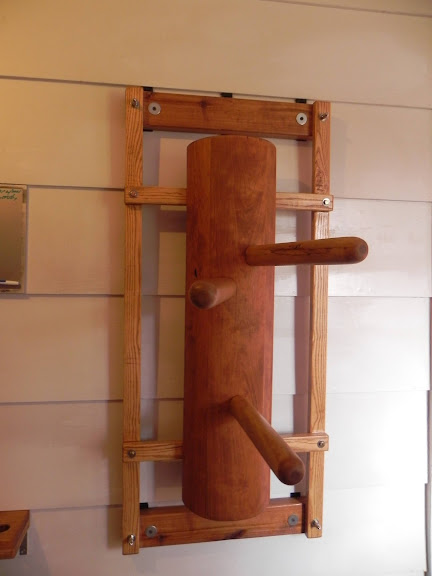
Look at the above picture. Ip Man is way cool. What do those Chinese artists have that I don't have?

Cool uniforms?...no I got them. Plus I have magician clothes.


Styles based on the animals?...no my wife says I have perfected Drunken Ass.


I know, the cool wooden dummy.

Wooden dummies are just plain neat. I have wanted one since I was 14. I got to play around on one when I was a Wing Chun student, but really I have not had the time to trance out on one.

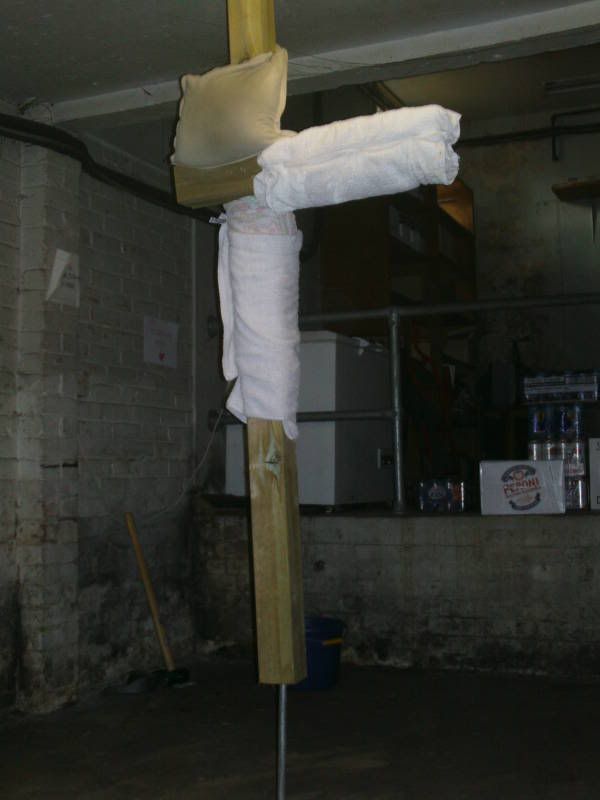
A few years ago it occurred to me that I was never going to shell out the money to buy one. The traditional dummies do not move in a way that would be helpful to my current martial training anyways. Then a spark of inspiration hit. I have so much crap in the garage. I bet there is a training dummy in here somewhere. 3 hours later I had a pretty good workable first version. Cost - free. I worked out on it for about an hour. I gotta say it was nice getting back to some sweaty garage training. This was the way I used to train 12 years ago - just losing myself, by myself. My current art form has the nice space, the students and all that, but there is something cool about having a little space at the house you can go trance out at.


Here is a video and picture of mine. My dummy is quite versatile.


Here is a collection of photos and videos from the net of other artists dummies. You can do it!


Inspiration


Wednesday, July 6, 2011

Right Here, Right Now


I first encountered this poet and calligrapher when I lived in Japan. His name is Aida Mitsuo. Some of my Japanese friends introduced me to his work, and tried to convince me of his cleverness. Above we see a piece of his work. His calligraphy is child-like and almost burped out onto the page. He even childishly uses the kana or phonetic alphabet rather then the refined kanji, or Chinese characters. On the surface I do not like this piece. BUT, I have remembered it for ten years...I have recreated it, I have found it's wisdom. OK, I like it.

It says "Ima Koko" - Now, Here. In the English language it is often translated as 'Right Here, Right Now'. This is a Zen idea. I reminds us that the past is gone, the future is unknown, and truly all we ever have is the right here and now. All thought, action, change, and work only happens in the now. Living in the past or for the future is not the way, because we will never be in the past or future, only the now.

For those of into Zen or the martial arts, we like to build myths about teachers. Eventually the teachers that came before us become symbols of what we can achieve if we follow the way. Often the teachers take on a quality of purity and perfection. For those of in the martial arts they become enlightened or invincible.

Ima Koko - 'Right Here, Right Now' beckons us out of the fantasy and mythology. So what is Mr Monk or Mr Teacher was so great? That was their path. That was their practice. The only practice and person you can ever be responsible for is yourself. Budo, the martial way and Zen did exist in the past, but largely it is irrelevant to you and me practicing right now. We stand on the shoulders of the great teachers that came before us, not so that we can copy their art. We don't try to become them, or deify their lives. We stand on their shoulders so we can practice the art and spiritual paths, right here and right now and come to our own own conclusion. Nothing else matters except what you do this moment.

So remember fellow travelers on the path. Live in the now and seize the day. Make every encounter with your teacher, student, coworker, wife and child meaningful. Show them who you truly are, and what you are working on becoming. The teachers that came before are mere legends. The teachers that are to come have not been shaped yet. There is only you - and you perpetually exist in the here and now.

"Do not look back. And do not dream about the future, either. It will neither give you back the past, nor satisfy your other daydreams. Your duty, your reward--your destiny are here and now."


~Dag Hammarskjold


Sunday, July 3, 2011

Enso

Zen teachers like to draw circles. Sometimes they draw them around from right to left, sometimes around from left to right. These circles can represent emptiness, fullness, or the moon. Or they can represent the practice. The circle that goes around from right to left-against the path of the sun on the sundial - represents the hard way of practice before any glimmer of understanding appears. When it goes around left to right, following the path of the sun, it represents the easier way of practice after a glimmer opens the Way. But both before and after glimmer, the practice requires investment and conscientious diligence.

-Robert Aitken


Here is one of my humble attempts. Again, photography cannot capture the 3 dimensional quality of this painting.


Thursday, June 30, 2011

Budo in the Matrix


Face it friends, things are changing out there. YouTube, FaceBook, online communities, cell phones, the blog-o-sphere are all now major tools in pushing forward martial arts in ways never imagined by the masters of old. Information is out there and easy to get at for the person willing to do some genuine searching and networking. People are coming together from styles around the globe that at one time had been fractured divisions. A new dawn of budo is here friends.

YouTube in and of itself is absolutely amazing. Artists from all over the world are posting lessons, demonstrations, form, tournaments, and lectures. I had been training for 6 years in Aikido before I ever saw a film of Ueshiba Sensei in action. I never saw his major students. Then, comes YouTube and it's all there and more.

In the Kaze Uta Budo Kai we are often filming entire seminars and posting them up. Our entire organization, and anyone curious to see what we are up to can keep updated with the latest trends.

Now much of this flies in the face of the old feudal system of budo. Secret clubs, all information coming from the master. People could be purposely not shown things, and secrets were kept. I know plenty of people who still train that way, but I am choosing to ride the information wave.

Social media like FaceBook is connecting people with budo interests from around the world. I know and communicate with the heads of systems and high ranked teachers from all over the world on my feed. We post videos, comment on each others works and write our inspirational and political thoughts to share. It is happening all the time. Many budoka are really plugged in to whats is going on with each other.

Online communities are continuously cropping up. Invariably you can find the biggest names in budo and martial academia on the big boards. You can correspond with people in China and Japan and get technical advice and translation work done.

The blog-o-sphere is another of the heavy hitting fronts in the new study of budo. Artists, newbies, thinkers, historians and dabblers are all out there publishing about niche arts and budo minutia around the clock. Bloggers to serve as net workers. Bloggers are a extended community anyhow that cross the martial arts boundaries. We are all watching each others arts and contributing to each others growth. I strongly feel my blog has brought me many of the important connections and relationships that now define my budo practice.

That ancient piece of technology the cell phone is now a cornerstone in my training regime. Nowadays there are no long distance charges, so I burn several hours a week talking in depth with teachers, students and fellow friends in budo. Though we are across the country, talking with top sensei is now a casual part of the day.

Like I said, times are rapidly changing friends. I think the next decades will bring an even greater wealth of budo knowledge to the fingertips of the students who genuinely want to learn. I feel we stand a shot, as long as we are still willing to put in the sweat work on making higher quality and more knowledgeable artists than have ever been before. There are no more secrets. LET THERE BE INFORMATION!

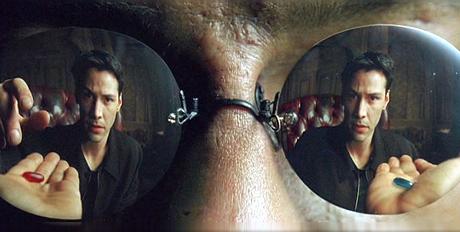
After analyzing youtube for hours, sometimes I return to the world feeling like Neo in the movie The Matrix after he was implanted with martial arts programs. I look up from the monitor and proclaim "I know kung fu."

Wednesday, June 29, 2011

Water Boxing Push Hands

I really like soft, slow, balance break push hands like this. I hope to be practicing like this a lot, later on in my career.

Tuesday, June 28, 2011

The Wave

Here is a painting I finally finished. It is probably 3 feet by 4 feet, and heavily textured. In person the thick paint leaps out of the canvas. Photography often cannot paintings well. I choose the wave, because I have always enjoyed Harakusai's painting. Waves are a pure expression of energy and motion. In fact my dojo symbol, the swirling spiral, is conceived after the wave. Of course there is a painful side to this too, now with the recent history of tragedy in Japan. All in all, the wave is an mandala for any student of aiki to lose themselves in.